GCMS
More information
WebinarsAbout usContact usTerms of use
LabRulez s.r.o. All rights reserved. Content available under a CC BY-SA 4.0 Attribution-ShareAlike
Author
Institute of Organic Chemistry and Biochemistry of the Czech Academy of Sciences
The Institute of Organic Chemistry and Biochemistry of the Czech Academy of Sciences (IOCB Prague) is a leading scientific institution in the Czech Republic, recognized internationally. Its primary mission is basic research in the fields of chemical biology and medicinal chemistry, organic and material oriented chemistry, chemistry of natural compounds, biochemistry and molecular biology, physical chemistry, theoretical chemistry, and analytical chemistry.
Tags
Article
Video
Scientific article
LinkedIn Logo

Scientists from IOCB Prague are expanding the possibilities of using RNA in gene medicine
Tu, 21.5.2024
| Original article from: IOCB Prague
Dr Petr Cígler and his collaborators are working on refining molecular systems for transporting ribonucleic acid (RNA) molecules into cells.
Video placeholder
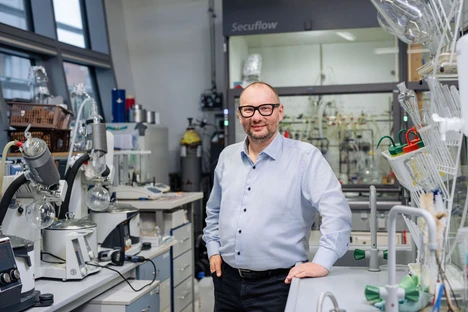
  • Photo: IOCB Prague/Tomáš Belloň: Dr. Petr Cígler, head of the senior research group Synthetic Nanochemistry at IOCB Prague.
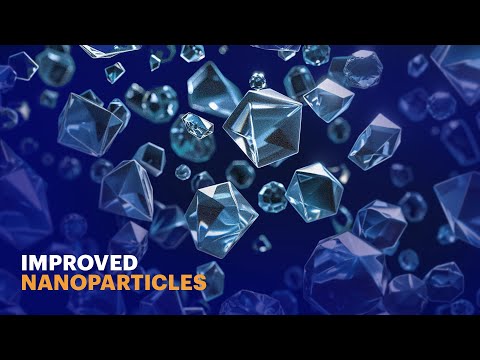
  • Video: IOCB Prague: Scientists from IOCB Prague are expanding the possibilities of using RNA in gene medicine.

Dr Petr Cígler and his collaborators are working on refining molecular systems for transporting ribonucleic acid (RNA) molecules into cells. The question of how to effectively deliver RNA to a designated place in the body in order to silence a malfunctioning gene is one of the greatest challenges of the rapidly developing field of gene medicine. Now, researchers from IOCB Prague have taken yet another significant step towards achieving this goal. They have described in detail the preparation of a novel composite vector nanomaterial for transporting RNA, in which they focused mainly on ensuring its non-toxicity to cells. The reason is that the harmfulness of hitherto known nucleic acid vectors presents a serious obstacle to the expansion of gene therapy. A new article on the topic has now been published in the scientific journal Advanced Functional Materials.

IOCB Prague/Tomáš Belloň: Dr. Petr Cígler, head of the senior research group Synthetic Nanochemistry at IOCB Prague.IOCB Prague/Tomáš Belloň: Dr. Petr Cígler, head of the senior research group Synthetic Nanochemistry at IOCB Prague.

Petr Cígler and his colleagues worked with the assumption that the toxicity of nucleic acid vectors is caused by an excessive accumulation of positive charges along the chains of carrier polymers that bind nucleic acids. Therefore, they systematically diluted this positive charge with uncharged monomers and found that its slight dilution did not impair the ability of the system to transport nucleic acids. In their thorough study, they also describe the circumstances under which new materials can be prepared for use in gene medicine. The researchers paid close attention to the conditions in which these substances bind nucleic acids most effectively and in what stoichiometric proportion.

Cells can regulate the translation of genes from mRNA to proteins in several ways. One of them is to silence a gene with the help of an siRNA (small interfering RNA) molecule. This blocks the production of the target protein, which is especially useful if the gene encoding is mutated or otherwise defective. In addition, it is possible to intervene if the innate mechanisms of translation regulation are impaired. In such a case, too much of a protein is produced in the body, which is detrimental to its health.

‘Gene therapy is not only highly effective, but also acutely targeted. Its biggest advantage lies in the fact that it accurately targets individual mutations or disorders without the danger of missing the mark. Using siRNA, it is possible to hit even a single mutated “letter” of a gene,’ says Marek Kindermann, the first author of the study, listing the main advantages of gene therapy. Currently, five drugs based on siRNA are approved for worldwide use, and there are about a dozen more on the ‘waiting list’.

IOCB Prague: Scheme of various engineering strategies for the production of cationic polymer-coated NPs.IOCB Prague: Scheme of various engineering strategies for the production of cationic polymer-coated NPs.

The therapeutic use of siRNA is hindered by the fact that siRNA molecules are unstable and therefore break down very quickly in the body. Experts around the world are therefore addressing the problem of how to deliver siRNA to a designated location and allow it to do its job, which is to stop or limit the production of a certain undesirable protein by silencing the gene for it. This task was also taken up by Petr Cígler's team at IOCB Prague, together with colleagues from the Institute of Microbiology of the Czech Academy of Sciences, led by the head of the Nanomedicine group, Dr Veronika Benson. And the results that they have achieved are truly excellent.

‘Each transport system is designed to meet two basic objectives: First of all, it has the task of protecting the molecule from decaying, and secondly, it must ensure its transport into the cell so that it reaches the cytosol and fulfills its mission as a drug there,’ explains Petr Cígler, adding: ‘In our study, we deal with the properties of the transport system in great detail. We descend all the way down to the level of structural minutiae of molecules that interact with nucleic acids. We describe the conditions necessary for siRNA to successfully bind to the transport nanosystem and then reach the intracellular space.’

Researchers from IOCB Prague are thus paving the way for the use of particles referred to as non-viral vectors, which do not utilize viruses to carry RNA. They have placed the entire transport system, including the nucleic acid, on the surface of diamond nanoparticles. These are markedly stable carrier particles, which also emit a special type of fluorescence. This makes it possible to track their journey through tissues and monitor how they behave inside cells. One complication is that it is difficult for the body to get rid of nanodiamonds, so this method of gene therapy is suitable mainly for the treatment of hard-to-heal superficial wounds. It is for these types of therapy, with a focus on healing leg ulcers in patients with diabetes, that the new transport nanomaterials, presented in this and other works by the team of Dr Cígler and collaborators, are intended.

Their latest in-depth study was also made possible thanks to the AMULET project, which focuses on the development of multi-scale nanomaterials and brings together eight partners led by the Jaroslav Heyrovský Institute of Physical Chemistry. The AMULET project has received financial support from the Operational Programme Johannes Amos Comenius, administered by the Ministry of Education, Youth and Sports of the Czech Republic, in the category of Cutting-Edge Research.

Resources
  • Kindermann, M.; Neburkova, J.; Neuhoferova, E.; Majer, J.; Stejfova, M.; Benson, V.; Cigler, P. Design Rules for the Nano-Bio Interface of Nanodiamonds: Implications for siRNA Vectorization. Adv. Funct. Mater. 2024, 2314088. https://doi.org/10.1002/adfm.202314088
Institute of Organic Chemistry and Biochemistry of the Czech Academy of Sciences
LinkedIn Logo
 

Related content

Quantitative Volatile PFAS Analysis in Textiles

Applications
| 2026 | Agilent Technologies
Instrumentation
GC/MSD, GC/MS/MS, GC/QQQ
Manufacturer
Agilent Technologies
Industries
Materials Testing

Effectiveness of the MonoTrap Collection Method for VOC Analysis in Exhaled Breath Using GC-MS

Applications
| 2026 | Shimadzu
Instrumentation
GC/MSD, Thermal desorption, GC/SQ
Manufacturer
Shimadzu
Industries
Clinical Research

Rapid analysis of organochlorine pesticides (OCPs) in soil samples using the EXTREVA ASE accelerated solvent extractor

Applications
| 2026 | Thermo Fisher Scientific
Instrumentation
Sample Preparation, GC
Manufacturer
Thermo Fisher Scientific
Industries
Environmental

Total Hydrocarbon Impurity Analysis in PEM Fuel Cell Grade Hydrogen Using the Agilent 8890 GC-FID System

Applications
| 2026 | Agilent Technologies
Instrumentation
GC
Manufacturer
Agilent Technologies
Industries
Energy & Chemicals

Analysis of Aroma Components in Apples Using the Smart Aroma Database

Applications
| 2026 | Shimadzu
Instrumentation
GC/MSD, GC/SQ, HeadSpace
Manufacturer
Shimadzu
Industries
Food & Agriculture
 

Related articles

The Effect of Needle Gauge and Flow Rate on Evaporation Rate
Article | Science and research

The Effect of Needle Gauge and Flow Rate on Evaporation Rate

The study evaluates how needle gauge, nitrogen flow rate, and needle design influence solvent evaporation rate during sample concentration and provides practical optimization guidance.
Organomation
tag
share
more
News from LabRulezGCMS Library - Week 11, 2026
Article | Application

News from LabRulezGCMS Library - Week 11, 2026

This week we bring you application notes by Agilent Technologies, Shimadzu and Thermo Fisher Scientific and poster by MDCW / C³AL!
LabRulez
tag
share
more
CATRIN researchers offer a “greener” way to make supercapacitors
Article | Science and research

CATRIN researchers offer a “greener” way to make supercapacitors

CATRIN scientists show that green solvents Cyrene and Tamisolve can replace toxic NMP in supercapacitor production while maintaining high electrochemical performance and enabling more sustainable manufacturing.
CATRIN
tag
share
more
Teaching Separation Science in High School
Interview | Scientists

Teaching Separation Science in High School

This interview explores how high school students learn separation science through filtration, gravimetric analysis, and chromatography, building the foundations for future chemistry studies.
Organomation
tag
share
more
 

Related content

Quantitative Volatile PFAS Analysis in Textiles

Applications
| 2026 | Agilent Technologies
Instrumentation
GC/MSD, GC/MS/MS, GC/QQQ
Manufacturer
Agilent Technologies
Industries
Materials Testing

Effectiveness of the MonoTrap Collection Method for VOC Analysis in Exhaled Breath Using GC-MS

Applications
| 2026 | Shimadzu
Instrumentation
GC/MSD, Thermal desorption, GC/SQ
Manufacturer
Shimadzu
Industries
Clinical Research

Rapid analysis of organochlorine pesticides (OCPs) in soil samples using the EXTREVA ASE accelerated solvent extractor

Applications
| 2026 | Thermo Fisher Scientific
Instrumentation
Sample Preparation, GC
Manufacturer
Thermo Fisher Scientific
Industries
Environmental

Total Hydrocarbon Impurity Analysis in PEM Fuel Cell Grade Hydrogen Using the Agilent 8890 GC-FID System

Applications
| 2026 | Agilent Technologies
Instrumentation
GC
Manufacturer
Agilent Technologies
Industries
Energy & Chemicals

Analysis of Aroma Components in Apples Using the Smart Aroma Database

Applications
| 2026 | Shimadzu
Instrumentation
GC/MSD, GC/SQ, HeadSpace
Manufacturer
Shimadzu
Industries
Food & Agriculture
 

Related articles

The Effect of Needle Gauge and Flow Rate on Evaporation Rate
Article | Science and research

The Effect of Needle Gauge and Flow Rate on Evaporation Rate

The study evaluates how needle gauge, nitrogen flow rate, and needle design influence solvent evaporation rate during sample concentration and provides practical optimization guidance.
Organomation
tag
share
more
News from LabRulezGCMS Library - Week 11, 2026
Article | Application

News from LabRulezGCMS Library - Week 11, 2026

This week we bring you application notes by Agilent Technologies, Shimadzu and Thermo Fisher Scientific and poster by MDCW / C³AL!
LabRulez
tag
share
more
CATRIN researchers offer a “greener” way to make supercapacitors
Article | Science and research

CATRIN researchers offer a “greener” way to make supercapacitors

CATRIN scientists show that green solvents Cyrene and Tamisolve can replace toxic NMP in supercapacitor production while maintaining high electrochemical performance and enabling more sustainable manufacturing.
CATRIN
tag
share
more
Teaching Separation Science in High School
Interview | Scientists

Teaching Separation Science in High School

This interview explores how high school students learn separation science through filtration, gravimetric analysis, and chromatography, building the foundations for future chemistry studies.
Organomation
tag
share
more
 

Related content

Quantitative Volatile PFAS Analysis in Textiles

Applications
| 2026 | Agilent Technologies
Instrumentation
GC/MSD, GC/MS/MS, GC/QQQ
Manufacturer
Agilent Technologies
Industries
Materials Testing

Effectiveness of the MonoTrap Collection Method for VOC Analysis in Exhaled Breath Using GC-MS

Applications
| 2026 | Shimadzu
Instrumentation
GC/MSD, Thermal desorption, GC/SQ
Manufacturer
Shimadzu
Industries
Clinical Research

Rapid analysis of organochlorine pesticides (OCPs) in soil samples using the EXTREVA ASE accelerated solvent extractor

Applications
| 2026 | Thermo Fisher Scientific
Instrumentation
Sample Preparation, GC
Manufacturer
Thermo Fisher Scientific
Industries
Environmental

Total Hydrocarbon Impurity Analysis in PEM Fuel Cell Grade Hydrogen Using the Agilent 8890 GC-FID System

Applications
| 2026 | Agilent Technologies
Instrumentation
GC
Manufacturer
Agilent Technologies
Industries
Energy & Chemicals

Analysis of Aroma Components in Apples Using the Smart Aroma Database

Applications
| 2026 | Shimadzu
Instrumentation
GC/MSD, GC/SQ, HeadSpace
Manufacturer
Shimadzu
Industries
Food & Agriculture
 

Related articles

The Effect of Needle Gauge and Flow Rate on Evaporation Rate
Article | Science and research

The Effect of Needle Gauge and Flow Rate on Evaporation Rate

The study evaluates how needle gauge, nitrogen flow rate, and needle design influence solvent evaporation rate during sample concentration and provides practical optimization guidance.
Organomation
tag
share
more
News from LabRulezGCMS Library - Week 11, 2026
Article | Application

News from LabRulezGCMS Library - Week 11, 2026

This week we bring you application notes by Agilent Technologies, Shimadzu and Thermo Fisher Scientific and poster by MDCW / C³AL!
LabRulez
tag
share
more
CATRIN researchers offer a “greener” way to make supercapacitors
Article | Science and research

CATRIN researchers offer a “greener” way to make supercapacitors

CATRIN scientists show that green solvents Cyrene and Tamisolve can replace toxic NMP in supercapacitor production while maintaining high electrochemical performance and enabling more sustainable manufacturing.
CATRIN
tag
share
more
Teaching Separation Science in High School
Interview | Scientists

Teaching Separation Science in High School

This interview explores how high school students learn separation science through filtration, gravimetric analysis, and chromatography, building the foundations for future chemistry studies.
Organomation
tag
share
more
 

Related content

Quantitative Volatile PFAS Analysis in Textiles

Applications
| 2026 | Agilent Technologies
Instrumentation
GC/MSD, GC/MS/MS, GC/QQQ
Manufacturer
Agilent Technologies
Industries
Materials Testing

Effectiveness of the MonoTrap Collection Method for VOC Analysis in Exhaled Breath Using GC-MS

Applications
| 2026 | Shimadzu
Instrumentation
GC/MSD, Thermal desorption, GC/SQ
Manufacturer
Shimadzu
Industries
Clinical Research

Rapid analysis of organochlorine pesticides (OCPs) in soil samples using the EXTREVA ASE accelerated solvent extractor

Applications
| 2026 | Thermo Fisher Scientific
Instrumentation
Sample Preparation, GC
Manufacturer
Thermo Fisher Scientific
Industries
Environmental

Total Hydrocarbon Impurity Analysis in PEM Fuel Cell Grade Hydrogen Using the Agilent 8890 GC-FID System

Applications
| 2026 | Agilent Technologies
Instrumentation
GC
Manufacturer
Agilent Technologies
Industries
Energy & Chemicals

Analysis of Aroma Components in Apples Using the Smart Aroma Database

Applications
| 2026 | Shimadzu
Instrumentation
GC/MSD, GC/SQ, HeadSpace
Manufacturer
Shimadzu
Industries
Food & Agriculture
 

Related articles

The Effect of Needle Gauge and Flow Rate on Evaporation Rate
Article | Science and research

The Effect of Needle Gauge and Flow Rate on Evaporation Rate

The study evaluates how needle gauge, nitrogen flow rate, and needle design influence solvent evaporation rate during sample concentration and provides practical optimization guidance.
Organomation
tag
share
more
News from LabRulezGCMS Library - Week 11, 2026
Article | Application

News from LabRulezGCMS Library - Week 11, 2026

This week we bring you application notes by Agilent Technologies, Shimadzu and Thermo Fisher Scientific and poster by MDCW / C³AL!
LabRulez
tag
share
more
CATRIN researchers offer a “greener” way to make supercapacitors
Article | Science and research

CATRIN researchers offer a “greener” way to make supercapacitors

CATRIN scientists show that green solvents Cyrene and Tamisolve can replace toxic NMP in supercapacitor production while maintaining high electrochemical performance and enabling more sustainable manufacturing.
CATRIN
tag
share
more
Teaching Separation Science in High School
Interview | Scientists

Teaching Separation Science in High School

This interview explores how high school students learn separation science through filtration, gravimetric analysis, and chromatography, building the foundations for future chemistry studies.
Organomation
tag
share
more
Other projects
LCMS
ICPMS
Follow us
FacebookX (Twitter)LinkedInYouTube
More information
WebinarsAbout usContact usTerms of use
LabRulez s.r.o. All rights reserved. Content available under a CC BY-SA 4.0 Attribution-ShareAlike