
GCMS
More information
WebinarsAbout usContact usTerms of use
LabRulez s.r.o. All rights reserved. Content available under a CC BY-SA 4.0 Attribution-ShareAlike
Organizer
Separation Science
Separation Science
Separation Science is the leading online resource for methods, applications, troubleshooting and training in chromatography and mass spectrometry.
Tags
RAMAN
LinkedIn Logo

Raman Spectroscopy for Li-ion Battery Material Diagnostics
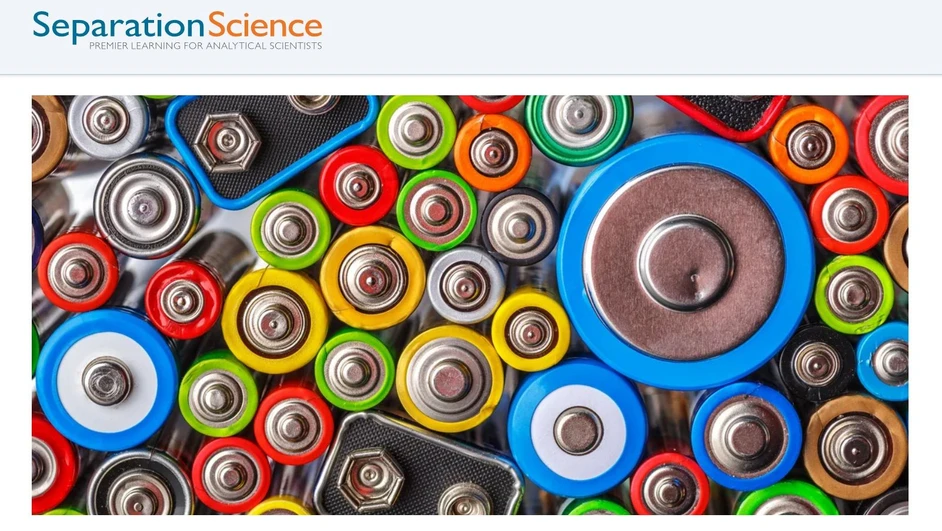
We, 11.3.2026 15:00 CET
This presentation explores the application of Raman spectroscopy as a non-destructive, high-resolution diagnostic tool for characterizing the electrode materials.
Go to the webinar
SeparationScience: Raman Spectroscopy for Li-ion Battery Material Diagnostics

The performance and safety of lithium-ion batteries (LIBs) are fundamentally linked to the structural and chemical stability of their electrode materials and electrolytes. This presentation explores the application of Raman spectroscopy as a non-destructive, high-resolution diagnostic tool for characterizing the electrode materials. Unlike traditional X-ray diffraction, Raman spectroscopy is very sensitive to local chemical environments, lattice dynamics, and amorphous phases, making it ideal for monitoring postsynthetic impurities, phase transitions, lithium-ion intercalation processes, and possible degradation mechanisms.

The presentation highlights the transition from static characterization to in situ and operando techniques, which allow for real-time observation of ionic transport and structural changes under actual operating conditions. By correlating Raman spectral changes with electrochemical performance, this diagnostic approach provides insights for optimizing material synthesis and further enhancing the energy storage safety.

By attending this webinar, you will:
  • Understand how Raman spectroscopy is applied as a non-destructive technique to characterize lithium-ion battery electrode materials and electrolytes.
  • Recognize the sensitivity of Raman spectroscopy to local chemical environments, lattice dynamics, amorphous phases, and degradation mechanisms.
  • Explain the role of in situ and operando Raman techniques in monitoring phase transitions and lithium-ion intercalation under operating conditions.
  • Relate Raman spectral changes to electrochemical performance to support material optimization and battery safety.

Presenter: Dominika Buchberger, PhD (Scientific Project Manager, Laboratory of Energy Storage Technologies and Applied Radiochemistry (LESTAR), Faculty of Chemistry, University of Warsaw)

Separation Science
LinkedIn Logo
 

Related content

Total Hydrocarbon Impurity Analysis in PEM Fuel Cell Grade Hydrogen Using the Agilent 8890 GC-FID System

Applications
| 2026 | Agilent Technologies
Instrumentation
GC
Manufacturer
Agilent Technologies
Industries
Energy & Chemicals

Analysis of Aroma Components in Apples Using the Smart Aroma Database

Applications
| 2026 | Shimadzu
Instrumentation
GC/MSD, GC/SQ, HeadSpace
Manufacturer
Shimadzu
Industries
Food & Agriculture

Analysis of Acetaldehyde and Limonene in Recycled PET Using an HS-GCMS System (Carrier Gas: H2)

Applications
| 2026 | Shimadzu
Instrumentation
GC/MSD, GC/SQ, HeadSpace
Manufacturer
Shimadzu
Industries
Energy & Chemicals

What Causes GC Capillary Column Performance Degradation, and How Can I Prevent It?

Technical notes
| 2026 | Agilent Technologies
Instrumentation
Consumables, GC columns
Manufacturer
Agilent Technologies
Industries
Other

Aromatic Component Analysis of Gasoline According to ASTM D5580 Using the Brevis GC- 2050 Gas Chromatograph

Applications
| 2025 | Shimadzu
Instrumentation
GC
Manufacturer
Shimadzu
Industries
Energy & Chemicals
Other projects
LCMS
ICPMS
Follow us
FacebookX (Twitter)LinkedInYouTube
More information
WebinarsAbout usContact usTerms of use
LabRulez s.r.o. All rights reserved. Content available under a CC BY-SA 4.0 Attribution-ShareAlike