

Rheo+Raman: Deeper Polymer Insights from Research to QC
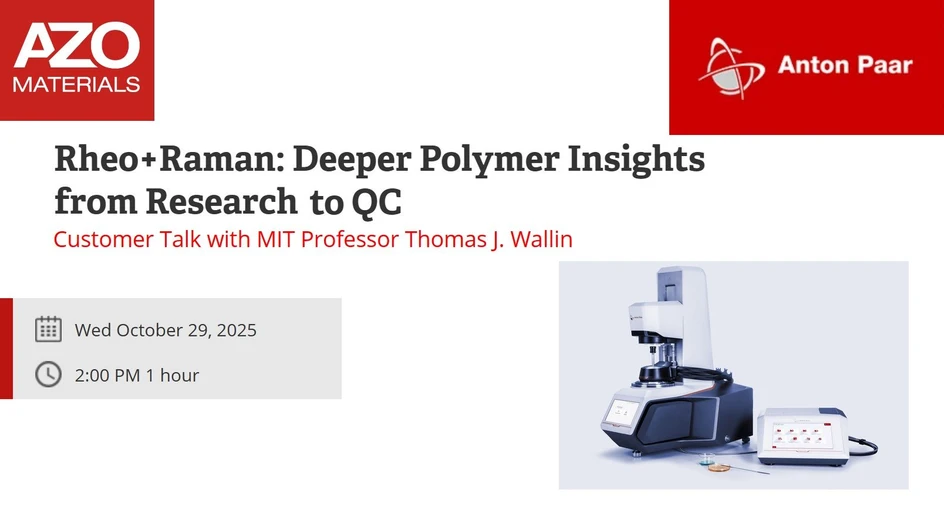
Customer Talk with MIT Professor Thomas J. Wallin
The combination of rheology and Raman spectroscopy offers unique opportunities for simultaneously measuring both the physical and chemical properties of a system. In this webinar, discover how the Anton Paar integrated Rheo+Raman system allows users to gain a deeper understanding of material properties in a matter of minutes.
The session opens with an introduction from Sunny Sidhartha, who will present an overview of the Anton Paar integrated Rheo+Raman system.
This is followed by an exclusive Customer Talk with Professor Thomas J. Wallin from the Department of Materials Science and Engineering at the Massachusetts Institute of Technology (MIT) in the US.
Professor Wallin will share how he uses Anton Paar’s Rheo+Raman system to monitor the UV curing of 3D printing polymers in real time. By combining the compact Cora 5001 Raman spectrometer with an MCR rheometer, he is able to replicate in situ conditions during manufacturing.
This enables a deeper understanding of the process-structure-property relationship in 3D-printed polymers, supports advanced formulation development, and helps identify optimal print parameters and quality control workflows for industrial applications.
Get access to the free “Polymer Processing e-Book,” which is available as a free webinar handout.
Attend This Webinar to:
- Learn about new research in the field of 3D printing polymers using soft materials
- Participate in a Q&A session with a subject matter expert
- Understand the principles and advantages of Raman spectroscopy
- Explore rheological applications that benefit from in situ, real-time Raman spectroscopy
- Discover how the combined system works and how easy it is to operate
Attend This Webinar If You:
- Study curing, structure, and performance in real time
- Combine flow behavior with chemical insights
- Develop advanced formulations with deeper material understanding
- Optimize manufacturing by monitoring transitions in situ
- Adopt faster, multifunctional characterization methods
- Refine 3D printing and curing workflows
Presenter: Sunny Sidhartha (Anton Paar GmbH, Global Market Development - Raman spectrometers)
Sunny Sidhartha is a technical sales and business development professional with over 15 years of experience across various industries such as NIR spectroscopy, oil and gas, and manufacturing. He holds a degree in mechanical engineering with a focus on metallurgy and welding from Punjab Technical University, India, and a business degree from the European School of Management and Technology, Berlin. At Anton Paar, he is currently responsible for global market development for the Cora 5001, the benchtop Raman analyzer.
Presenter: Professor Thomas J. Wallin (Department of Material Science, Massachusetts Institute of Technology)
Professor Wallin earned a BS in physics and chemistry from the College of William and Mary, Virginia, in 2010, and an MS and a PhD in materials science and engineering from Cornell University, which he completed in 2018. Before joining MIT, he was a research scientist in soft wearable technologies at Meta’s Reality Labs Research, which focuses on immersive technologies.
He has extensive expertise in additive manufacturing, particularly the use of soft materials in 3D-printed devices. At MIT, his research focuses on advancing soft wearable devices. His group combines materials, chemistry, advanced manufacturing, and mechanical design to develop new technologies that expand the complexity and functionality of soft machines.


