

ASMS: 2nd Winter Conference
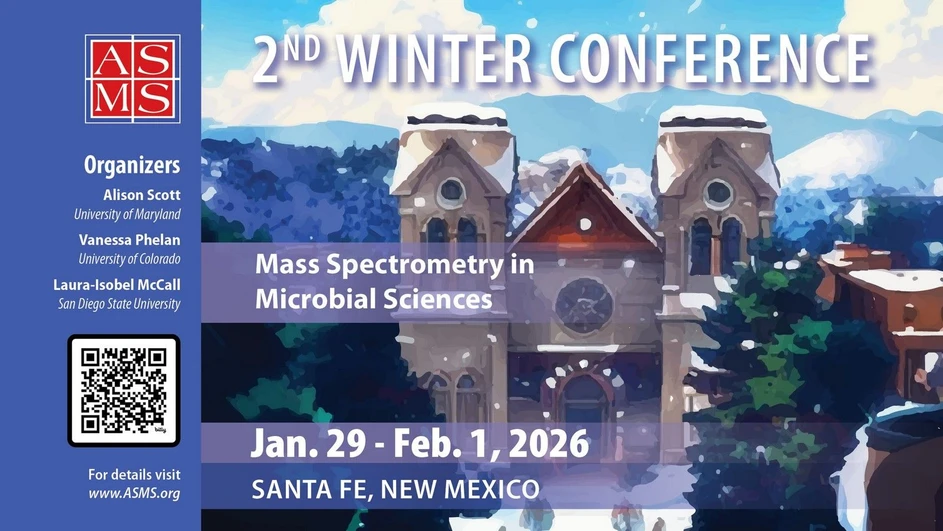
2nd ASMS Winter Conference: Mass Spectrometry in Microbial Sciences
Microbial sciences represent a rapidly growing space for the development and application of mass spectrometry-based techniques. Over the past 40 years, notable advances in this field include: MS-based microbial diagnostics, elucidation of novel pathogenic mechanisms, development of mass spectrometry approaches to enable discovery of new natural products, and advancements in data analysis tools for investigating non-canonical organisms. Due to rapid advancements in mass spectrometry technology and informatics, the application of mass spectrometry to microbial sciences has reached an inflection point and we expect exponential growth of this field in coming years.
The conference will showcase leading work in the development (e.g., instrumentation, methods, data analysis, etc.) and application (e.g., natural products discovery, biotransformation, microbiome research, etc.) of mass spectrometry to microbial systems. Join us for a unique opportunity to gather mass spectrometrists and forward-thinking microbiologists.
ASMS profile and content on LabRulezGCMS
ASMS profile and content on LabRulezLCMS
ASMS profile and content on LabRulezICPMS
Registration
Advance Deadline is December 19
Registration Fees
Before December 19, 2025
- $400, ASMS Members (Regular and Emeritus)
- $600, Non-Members
- $175, Students*
* Must be a full-time student in a degree program.
$200 Offsite Fee, if you are not a local resident and not staying at the La Fonda on the Plaza Hotel.
After December 19, 2025
- $450, ASMS Members (Regular and Emeritus)
- $650, Non-Members
- $225, Students*
Registration Cancellation Policy
Written notification of registration cancellations received on or before January 9 will be refunded less a $50 cancellation fee. Please send written notice of cancellation to [email protected].
Abstract Submission
Deadline: December 12, 2025
After the December 12 deadline, we will review all submissions and send out acceptance or rejection emails the week of December 22. If your abstract is accepted, you will have three days after being notified of your acceptance to withdraw your abstract.
Session Preference Options for Abstract Submission
- Poster. This option is available to any interested person (student through PI, all sectors).
- Short Talk. There are a very limited number of these slots available. Abstracts not selected for hot topic short talk will be contacted to confirm poster-only presentation. Abstracts which are selected will give oral presentation only (no poster).
Word Limits and Instructions for Submission
Before entering your abstract, assemble the following:
- Step 1:
- Abstract
- Title – Limit 20 words
- Introduction – Limit 120 words
- Methods – Limit 120 words
- Preliminary data – Limit 300 words
- Novel aspect – Limit 20 words
- Conflict of Interest - List your conflicts of interest or indicate there are no conflicts.
- Step 2: Authors - Enter ALL of the co-author names, affiliations (institute/company) and their email address. The submitter's name automatically appears as an author. It is possible to delete once additional authors are added. Be sure to designate only ONE of the authors as the Presenter (green checkmark). IMPORTANT: Help recognize your co-authors correctly by carefully entering their name as it commonly appears on their publications.
- Step 3: Session selection - If you wish to be considered for an Oral you will be prompted for a 1st and 2nd choice. There is no oral-only option, you must be willing to present a poster if you opt for oral consideration. For poster-only, simply skip the oral session preferences.
- Step 4: Questions - these relate to the designated PRESENTER of this abstract. The information is collected to help ASMS arrange oral sessions that remain diverse, balanced, and appropriately reflect the composition of the membership. Presenters will not be penalized or overlooked for any given response, or for the selection of the “Do Not Wish to Provide” option. The answers to all questions will be visible to reviewers only in the context described above.
- The answers to these questions will NOT be included in the abstract submission receipt. To change an answer or revisit the answers selected, the person submitting this abstract may sign-in and select 'View my drafts and submissions'.
- Step 5: Review and Submit - Your abstract will not be submitted until you click "Submit Abstract" at the end. You and your co-authors will receive an email receipt to confirm your submission. Please note that the questions and answers (step 4) will NOT be included in the submission email receipt. Abstract entry sessions will time out after 10 minutes of inactivity. If you leave your computer and come back to it after the auto-timeout you will need to log back in.
Preliminary Program
Thursday, January 29
5:00 - 7:00 pm Registration open
5:00 - 7:00 pm Poster Setup
7:00 - 7:10 pm Opening Remarks
7:10 - 8:00 pm Keynote Lecture: "Molecular Heterogeneity at the Host-Pathogen Interface"
- Eric Skaar (Vanderbilt University)
8:00 - 8:10pm Keynote Q&A
8:10 - 10:00 pm Reception
Friday, January 30
7:45 - 8:30am Continental breakfast
8:30 - 10:05 am Clinically Important Microbes - Detection & Characterization
- Ian Lewis (University of Calgary)
- Andreas Roempp (University of Bayreuth) "MS Imaging in Drug Development: The Clinical-Stage Antibiotic BTZ 043 Accumulates and Efficiently Acts Against Mycobacterium tuberculosis in Tuberculosis Lesions"
- Robert Ernst (University of Maryland)
10:15- 10:35 am Coffee Break
10:35 am - 12:05 pm Clinically Important Microbes - Detection & Characterization
- Neha Garg (Georgia Institute of Technology), "Metabolomics to Decode Drug-Microbe, Microbe-Microbe and Microbe-Host Interactions in the Genus Burkholderia"
- Short Talks from submitted abstracts
12:10 - 1:15 pm Lunch (provided by ASMS) and Group Photo
1:15 - 3:00 pm Microbial Systems: Interactions (Food, Microbiome, & More)
- Laura Sanchez (UC, Santa Cruz), "This Might Sound Cheesy, But We Need to Know More About Fungal Metabolites
- Jessica Prenni (Colorado State University), "Sourdough-Omics: Using Modern Analytical Approaches to Understand an Ancient Fermented Food"
- Daniel Globish (Science for Life Laboratory), "Chemical Metabolomics - Novel Chemical Biology Tools to Explore Gut Microbiota and Nutrition Metabolism"
3:00 - 3:20 pm Coffee Break
3:20 - 4:55 pm Microbial Systems: Interactions (Food, Microbiome, & More)
- Peter Turnbaugh (UC, San Francisco)
- Short Talks from submitted abstracts
4:55 - 7:00pm Dinner, on your own
7:00 - 9:00 pm Poster Session I
Saturday, January 31
7:45 - 8:30am Continental breakfast
8:30 - 10:15 am Microbial Systems: Fungal, Plant & Environmental
- Timo Niedermeyer
- Jennifer Geddes-McAlister (University of Guelph)
- Marcy Balunas (University of Michigan), "Metabolomics Outcomes as a Function of Biological Complexity from Microbiome Samples"
10:15 - 10:35 am Coffee Break
10:35 am - 12:10 pm Microbial Systems: Fungal, Plant & Environmental
- Christopher Anderton (PNNL), "Advancement of Molecular Cartography Tools for Mapping Environmental Microbiomes…and the Future of Microbial Molecular Phenotyping"
- Short Talks from submitted abstracts
12:10 - 7:00 pm Free Time
7:00 - 9:00 pm Poster Session II (bar, light on food)
Sunday, February 1
7:45 - 8:30 am Continental breakfast
8:30 - 10:15 am Meeting Challenges & Emerging Trends in Microbial MS
- Erin Carlson
- Kai Zhang (Texas Tech University), "Using Lipidomics to Study Leishmania-Host Interaction"
- Allegra Aron, (University of Denver)
10:15 - 10:45 am Coffee Break
10:35 am - 12:10 pm Meeting Challenges & Emerging Trends in Microbial MS
- Sizun Jiang (Harvard University)
- Short Talks from submitted abstracts
12:10 - 1:10 pm Lunch, on your own
1:10 - 2:00 pm Closing Keynote Lecture, John Belisle (Colorado State University)
2:00 - 2:20pm Closing remarks and Bon Voyage
- Optional Departures Depending upon Flights.
Monday, February 2
Departures at Leisure
Speakers & Session Topics
Keynote Speakers
- Eric Skaar (Vanderbilt University), Molecular Heterogeneity at the Host-Pathogen Interface
- John Belisle (Colorado State University)
Session Topics
Clinically Important Microbes - Detection & Characterization
- Ian Lewis (University of Calgary)
- Andreas Roempp (University of Bayreuth), MS Imaging in Drug Development: The Clinical-Stage Antibiotic BTZ 043 Accumulates and Efficiently Acts Against Mycobacterium tuberculosis in Tuberculosis Lesions
- Robert Ernst (University of Maryland)
- Neha Garg (Georgia Institute of Technology), Metabolomics to Decode Drug-Microbe, Microbe-Microbe and Microbe-Host Interactions in the Genus Burkholderia
Microbial Systems: Interactions (Food, Microbiome, & More)
- Laura Sanchez (UC-Santa Cruz), This Might Sound Cheesy, But We Need to Know More About Fungal Metabolites
- Jessica Prenni (Colorado State University), Sourdough-Omics: Using Modern Analytical Approaches to Understand an Ancient Fermented Food
- Daniel Globish (Science for Life Laboratory), Chemical Metabolomics - Novel Chemical Biology Tools to Explore Gut Microbiota and Nutrition Metabolism
- Peter Turnbaugh (UC-San Francisco)
Microbial Systems: Fungal, Plant & Environmental
- Jennifer Geddes-McAlister (University of Guelph)
- Marcy Balunas (University of Michigan), Metabolomics Outcomes as a Function of Biological Complexity from Microbiome Samples
- Mingxun Wang (UC-Riverside)
- Christopher Anderton (PNNL), Advancement of Molecular Cartography Tools for Mapping Environmental Microbiomes…and the Future of Microbial Molecular Phenotyping
Meeting Challenges & Emerging Trends in Microbial MS
- Kai Zhang (Texas Tech University), Using Lipidomics to Study Leishmania-Host Interaction
- Kelly Hines (University of Georgia), Ion Mobility-Mass Spectrometry for Rapid Multi-Omics in Microbial Diagnostics
- Allegra Aron (University of Denver)
- Sizun Jiang (Harvard University)


