20th International Interdisciplinary Meeting on Bioanalysis – CECE 2026
Dear Friends and Colleagues,
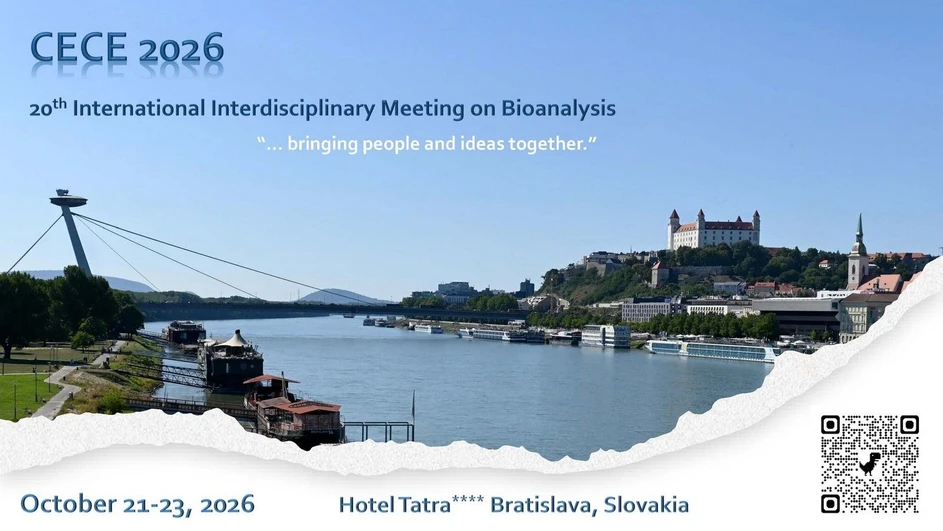
It is our great pleasure to invite you to the 20th International Interdisciplinary Meeting on Bioanalysis – CECE 2026, wich will take place from October 21 – 23, 2026, at Hotel Tatra**** in Bratislava, Slovakia.
Following the long successful tradition of CECE, this meeting aims to bring together scientists from fields of bioanalysis who may not often meet at the same events. The conference will feature plenary and keynote lectures by distinguished experts, contributed oral presentations, and interactive poster sessions encouraging active discussions and new collaborations across various scientific fields. The scientific program will cover advances and applications in analytical separation techniques, microfluidics, (bio)pharmaceutical and clinical analysis, omics, nanotechnology in bioanalysis, data analysis, and AI in bioanalytical sciences. A special CECE Junior section will be organized to support the next generation of scientists and to provide a platform for PhD students and young researchers to present their work, practice scientific communication, and build future collaborations.
We are excited to bring the CECE meeting for the first time in Slovakia and welcome the scientific community to Bratislava, a vibrant Central European city known for its rich history and charming atmosphere. Hotel Tatra, located in the heart of the city, will provide a comfortable and friendly enviroment for both scientific and social interactions. In addition to the scientific program, we are preparing networking events and oportunities to explore the cultural heritage and culinary delights of Slovakia’s capital.
We warmly invite you to join us in Bratislava and help us make CECE 2026 a memorable and successful meeting.
We look foward to welcoming you in October 2026 at CECE in Bratislava!
Katarína Maráková (Chair of the Conference)
Jana Lavická (Co-chair of the Conference)
Registration
Registration will be open soon
Registration fees
Early bird (until 30th June 2026)
- Regular participant: 350 €
- *Student: 210 €
- Accompanying person: 150 €
Regular fee (until 6th September 2026)
- Regular participant: 400 €
- *Student: 250 €
- Accompanying person: 150 €
The registration fee includes attendance to all lectures, coffee breaks, lunch (22nd and 23rd October 2026) and welcome event and conference dinner.
Abstract Submission
- The official language of the conference is English.
- Deadline for abstract submission is 6th September 2026.
- Abstract must be submitted in the Word document template provided here (.docx file). You may apply for an oral or poster presentation (please specify in the document title).
- Document in Word must be sent to [email protected].
- Subject line: „Abstract submission to CECE 2026“
- File name: abstract_oral_name.docx OR abstract_surname_name.docx
Topics
The scientific program will cover advances and applications in:
- ANALYTICAL SEPARATION TECHNIQUES
- (BIO)PHARMACEUTICAL AND CLINICAL ANALYSIS
- OMICS
- ELECTROCHEMICAL AND OPTICAL BIOSENSORS
- FOOD AND ENVIROMENTAL BIOANALYSIS
- NOVEL MATERIALS & NANOTECHNOLOGY IN BIOANALYSIS
- MICROFLUIDICS AND LAB-ON-A-CHIP
- FORENSICS
- DATA ANALYSIS AND AI IN BIOANALYTICAL SCEINCES
Programme
Plenary Speakers
Model matters: differential cellular outcomes and post-translational modifications following alpha-synuclein overexpression in neuronal cell lines
- Dominika Fričová (Comenius University Bratislava, Slovakia)
Dominika Fričová, MD. PhD., is the Head of the Laboratory of Translational Research of Neurodegenerative Diseases at the Second Department of Neurology, Comenius University in Bratislava. Her research group focuses on unravelling cellular and molecular mechanisms involved in the pathogenesis of Parkinson’s disease, with a particular emphasis on cellular senescence, mitochondrial dysfunction, and alpha-synuclein pathology. Her team works with various cellular models, including patient-derived cells, aiming to uncover novel therapeutic strategies and develop approaches for early diagnosis. A significant part of the group’s recent work investigates the role of extracellular vesicles as messengers in cell-to-cell communication, as well as their potential as early biomarkers of Parkinson’s disease.
Noninvasive diagnosis of invasive infectious diseases.
- Vladimír Havlíček (Institute of Microbiology, Czech Academy of Sciences, Prague, Czechia)
Vladimír Havlíček is an analytical chemist and mass spectrometrist who heads the Laboratory of Molecular Structure Characterization at the Institute of Microbiology (Prague, Czech Republic), bringing together microbiology, mass spectrometry, NMR, and electron microscopy. He investigates how microbial virulence factors and host immune defenses compete for metals and shape pathogen adaptation. His group demonstrated neutrophil lipocalin-2 capture of the siderophore enterobactin, showed copper detoxification through yersiniabactin complexes, and evaluates immune-evasive metallophores. He translates fungal siderophores into diagnostics for invasive mixed infections and pairs them with host markers such as pentraxin-3, which binds fungal galactosaminogalactan. Havlíček pioneered “infection metallomics,” a mass-spectrometry toolkit for 3D molecular profiling of soft tissues, and applies native MS/NMR to noncovalent complexes. After a 2022 sabbatical with K.A. Schug and D.A. Stevens and strategy building with Stanford clinicians, he focuses on lung, CNS, and urogenital infections, while teaching as a professor, publishing, and mentoring across international teams.
Recent innovations and improvements for CE in pharmaceutical analysis
- Cari Sänger – van de Griend (Kantisto BV, Netherlands)
Keynote Speakers
Advances in sustainable sample preparation for neuro-relevant bioanalysis: endocannabinoids as a case study
- Tomasz Bączek (Medical University of Gdańsk, Poland)
Prof. Tomasz Bączek, PhD, DSc, is a specialist in pharmacy and pharmaceutical analysis. At the Medical University of Gdańsk, he has served as Chair of the Department of Pharmaceutical Chemistry since 2009. His research focuses on analytical and bioanalytical chemistry, with particular emphasis on modern separation techniques, proteomics, targeted metabolomics, and the analysis of clinical biomarkers. His scientific output includes publications on LC–MS, capillary electrophoresis, microextraction techniques, and QSAR/QSRR modelling. He is a co-creator of innovative solutions for the analysis of biological samples, including sorbents and analytical devices developed using 3D printing technologies. He collaborates with numerous scientific and medical teams on projects related to the diagnosis, therapy, and monitoring of health conditions.
Epitachophoresis – principles and applications for DNA and protein concentration.
- František Foret (Institute of Analytical Chemistry, Czech Academy of Sciences, Brno, Czechia)
František Foret is the director of the Institute of Analytical Chemistry in Brno. In 1991, he received a CSc (PhD) degree and, in 2017, a DSc degree from the Academy of Sciences of the Czech Republic. After a postdoctoral fellowship (1991) at the Barnett Institute of Northeastern University in Boston, he spent nine years there as a research group leader (1992-2001). After returning to Brno, he founded and headed the Department of Bioanalytical Instrumentation until 2022. His main research interests include capillary separation, laser detection, miniaturization, and coupling with mass spectrometry. He serves as "senior deputy editor" of Electrophoresis and is a member of the Learned Society of the Czech Republic. Dr. Foret has authored and co-authored over 200 WoS-listed publications, including a monograph on capillary zone electrophoresis, 16 book chapters, and dozens of invited and plenary lectures, as well as 25 patents.
Capillary gel electrophoresis analysis of the forced degradation study products of a therapeutic monoclonal antibody
- András Guttman (University of Debrecen, Hungary)
András Guttman is heading the Horváth Csaba Memorial Laboratory of Bioseparation Sciences in University of Debrecen (Hungary) and the Translational Glycomics Research Group in University of Pannonia (Veszprem, Hungary). His work mainly focuses on capillary gel electrophoresis and its hyphenation to mass spectrometry for glycomics and glycoproteomics applications of biomedical and biopharmaceutical interests. Dr Guttman has published more than 400 scientific papers, and 38 book chapters, authored 1 and edited 4 textbooks, and holds 26 patents. He is a member of the Hungarian Academy of Sciences, recognized by numerous international awards, Editor in Chief for Current Molecular Medicine, and serves as an editorial board member for a dozen scientific journals.
Multimodal Liquid Chromatography for Characterizing Advanced Drug Formulations
- Kevin A. Schug (University of Texas at Arlington, TX, USA)
Kevin A. Schug, Ph.D. is the Shimadzu Distinguished Professor of Analytical Chemistry at the University of Texas at Arlington. He received his Ph.D. in chemistry from Virginia Tech under the direction of Professor Harold M. McNair. He performed post-doctoral research with Prof. Dr. Wolfgang Lindner at the University of Vienna. Since 2005, his research has focused on developing novel applications of various sample preparation, chromatography, mass spectrometry, and spectroscopy techniques. He has published more than 230 articles, presented more than 190 invited talks, and graduated 24 Ph.D. and 19 M.S. students. In 2024, he was presented with the Silver Jubilee Medal from The Chromatographic Society (UK) and he was a Fulbright – Palacky University Distinguished Scholar at Palacky University in Olomouc, CZ.
When antibiotics are not enough: Resistance and persistence in obligate intracellular pathogen Coxiella burnetii
- Ľudovít Škultéty (Biomedical Research Center, Slovak Academy of Sciences, Bratislava, Slovakia)
Ľudovít Škultéty is a leading scientist and Head of the the research group of Rickettsiology at the Institute of Virology, Biomedical Research Center of the Slovak Academy of Sciences. His research focuses on obligate intracellular bacteria, particularly Coxiella burnetii, with emphasis on host–pathogen interactions, antibiotic resistance, and biomarker discovery using advanced proteomic and mass spectrometry approaches. He is a key member of the National Reference Centre for the surveillance and laboratory diagnosis of rickettsioses in Slovakia and has coordinated numerous national and international research projects. His work bridges fundamental microbiology with translational applications, including diagnostics, vaccine-related antigens, and alternative therapeutic strategies. He is the recipient of multiple awards from the Slovak Academy of Sciences for international collaboration, infrastructure development, and outstanding scientific contributions.
- Andrea Vojs-Staňová
Venue
HOTEL TATRA * * * *
Námestie 1. mája 5, 81 106, Bratislava
ACCOMODATION
Hotel Tatra is located directly in Bratislava city centre. Hotels in the old town are within 10 – 15 min walking distance or a short public transport ride (closest bus stops Hodžovo námestie and Kollárovo námestie).