


Research overview
Research at the Department of Analytical Chemistry covers three fields:
- study of chemical and physical processes underlying analytical measurements;
- construction of laboratory equipment and modification of instruments for analytical measurements;
- real-life applications in various areas.
Studies of electrochemical conversion, ionization in mass spectrometric measurements or on-line preconcetration in capillary electrophoresis fall into the first field. Several apparatuses have been developed, e.g. microfluidic devices for cheap analyses, ionization sources for mass spectrometry (MS) such as desorption electrospray allowing direct analysis of reaction products on the surface of an electrode, or an interface for coupling of laser ablation with synchronous ionisation by electrospray and inductively couple plasma (ICP). Connection of capillary electrophoresis with ICP-MS provides extremely sensitive detection. The designed, constructed and patented circuit for measurements of low conductivity of surfaces can find use beyond the field of analytical chemistry. Regarding applications, our department deals with analysis of biological samples (release of metals from joint implants, metabolite identification or analysis of disease markers), forensic evidence (drug detection, gunshot residue on latent fingerprints), as well as archaeological samples or material analysis of pieces of art.
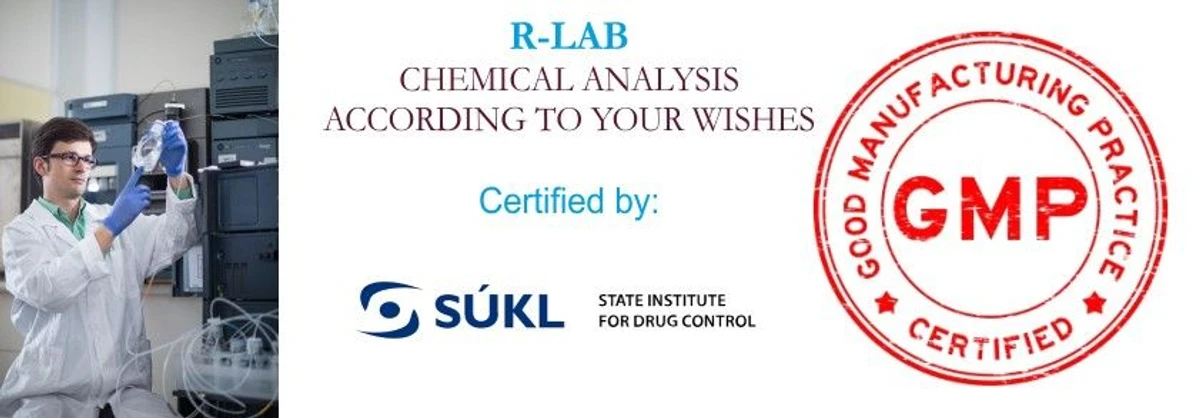
Our department runs a laboratory certified by the State Institute for Drug Control, which plays the key role in the area of pharmaceutical analysis. Joint research in collaboration with leading Czech and foreign institutions (such as University of Texas at Arlington, USA; Institute of Chemical Methodologies, Italian National Research Council, Rome, Italy; University of Vienna, Austria; University of Washington, Seatle, USA; University of Szeged, Hungary; Comenius University in Bratislava, Slovakia) is being conducted. The achieved results are published in international scientific journals, protected by domestic as well as foreign patents or provided, based on contract research, to our industrial partners (TEVA, Zentiva, Contipro and others).
R-lab: chemical analysis according to your wishes
Know-how, research and analysis in GMP certified control laboratory (certificate from the State Institute for Drug Control) and top instrumentation destines R-lab for solving of complicated research and development issues,carrying out demanding physical-chemical measurements for industrial partnes, medical companies, and other R&D workplaces. The laboratory ensures application of up-to-date research findings and top analytical instrumentation while solving tasks of pharmaceutical analysis.
R-lab can offer:
- Pharmaceutical analysis under GMP including method development, method validation and routine measurements
- Determination of elemental impurities in various samples by ICP-MS
- HPLC with UV or MS detection for analysis of major components in various samples
- HPLC with UV or MS detection for analysis of trace organic impurities in various samples
- Structure elucidation of unknow impurities
- Solubility and degradation studies
- Risk analysis and other GMP documents preparation
- Consultation, workshops, trainings
The laboratory manages modern and unique instrumentation:
- HPLC with UV-Vis detector (Acquity UPLC I-class, Waters)
- Liquid chromatograph with tandem mass spectrometer (triple quad Xevo-TQS)
ICP-MS (Agilent 7700x) - Microwave digestion units (Milestone ULTRAWave, Milestone MLS 1200 mega, Uniclever II)
Contact
Dr. Tomáš Pluháček
- e-mail: [email protected]
- phone: +420 585 63 4542
 Department of analytical chemistry: R-Lab GMP certified lab
Research Centre of the Joint Laboratory for Materials and Analytical Technologies (SMALT)
The project is focused on establishing a new Research Centre of the Joint Laboratory for Materials and Analytical Technologies (SMALT) and equipping it with key instrumental infrastructure. Its primary mission is to provide innovative services to the applied sector in the field of physical and chemical analysis and characterization of raw materials, materials, products manufactured and used by small and medium-sized enterprises (SMEs), as well as production waste, within the framework of the Integrated Territorial Investment (ITI) strategy in the Olomouc agglomeration (OA).
The project is implemented at Palacký University Olomouc (UP). The SMALT Centre will operate within the premises of the Faculty of Science, UP (17. listopadu 1192/12) and the Science and Technology Park UP (Šlechtitelů 813/21, 779 00 Olomouc). Establishing and operating the SMALT Centre modernizes the existing instrumental infrastructure with cutting-edge equipment, expanding cooperation opportunities between UP departments and the applied sector, particularly within the Olomouc agglomeration and beyond.
Key Instrumental Infrastructure
The project includes acquisition of advanced combined analytical technologies:
- High-performance capillary electrophoresis coupled with tandem mass spectrometry (CE/MS)
- Ultra-high-performance liquid chromatography coupled with high-resolution tandem mass spectrometry (UHPLC/HRTMS)
- X-ray microfluorescence spectrometer (mXRF)
- Two cryostats and two detectors for Mössbauer spectroscopy
Together with existing instrumentation and expertise, this portfolio enables strong synergistic acquisition of valuable physical and chemical data related to industrial products and manufacturing processes. The extensive technical background of participating research units allows the centre to address even the most complex challenges of the applied sector.
Core Project Objectives
- Establishment of the SMALT Centre
- Acquisition of key instrumental infrastructure enabling services for the applied sector
- Creation of an open partnership network involving relevant applied-sector entities
- Pilot operation of innovative services for SMEs, followed by continued operation during the sustainability phase of the project
Services of the SMALT Centre
- Support for SMEs in the Olomouc agglomeration in research and innovation (R&I)
- Development and implementation of analytical methods and techniques for quality control and characterization of materials and products, increasing competitiveness and sustainability
- Competence development of staff and teams in participating companies through joint educational activities
Instrumentation
UHPLC/HRTMS (Ultra-High-Performance Liquid Chromatography with High-Resolution Tandem Mass Spectrometry)
This system combines chromatographic separation in liquid phase with high-resolution tandem MS detection. It enables analysis of extracts from highly complex samples relevant to collaborating SMEs. The system supports both targeted and untargeted structural analysis, including discovery of previously unknown compounds.
Advanced software tools enable:
- De novo structural elucidation based on accurate mass and MS/MS fragmentation
- Multivariate statistical analysis for product comparison, process optimization, advanced pharmaceutical control, and authenticity assessment
CE/MS (Capillary Electrophoresis with Tandem Mass Spectrometry)
This system separates analytes in an electric field and is particularly suited for ionic and highly polar compounds, both organic and inorganic. It is highly complementary to UHPLC/HRTMS and enables strong synergistic effects.
Applications include:
- Analysis of highly acidic industrial wastewater
- Characterization of nanomaterials in solution
One project objective is to further integrate this still underutilized technique into applied-sector services.
Micro X-ray Fluorescence Spectrometry (mXRF)
mXRF enables precise elemental analysis of metals, alloys, slags, sediments, geological samples, and more. It is a non-destructive atomic spectroscopic method for solid samples and allows elemental mapping over areas up to 220–200 mm.
Key applications include:
- Engineering and metallurgy
- Medical materials
- 3D printed products
- Artworks and historical artifacts
Compared to SEM-EDS, mXRF provides volumetric (bulk) information rather than only surface analysis. Focused beam sizes of 5/10 mm allow detailed study of alloying element distribution.
Mössbauer Spectroscopy (Detectors and Cryostats)
Mössbauer spectroscopy enables detailed characterization of metallic materials, particularly those containing ⁵⁷Fe. It allows non-destructive phase analysis (e.g., retained austenite), bulk and surface characterization, and depth selection from 300 nm to 100 mm.
Industrial applications include:
- Temperature-dependent phase diagram studies of steels
- Determination of blocking temperatures of nanomaterials
- Analysis of iron-containing pharmaceuticals
The strong expertise of the Department of Experimental Physics in Mössbauer technology development enhances the innovative potential and competitive advantage of the SMALT Centre.
Contact (Principal Investigator)
- Assoc. Prof. Petr Bednář, Ph.D.
- [email protected]
Wrote about us

19th CSSC 2026: Early Bird Registration and Abstract Submission Deadline Approaching


Related content
Run Smarter, Go Greener: Smart Energy Saving In Nexis GC-2060
Gas Chromatograph Mass Spectrometer GCMS-TQ RX Series
Hydrogen Carrier Gas Method Translation in Comprehensive Two- Dimensional Gas Chromatography for Sustainable Nontargeted Analysis


