Let’s call a PT scheme a PT scheme!
Eurachem: Let’s call a PT scheme a PT scheme!
Interlaboratory comparisons (ILCs) have been used for more than a century and many important concepts are linked to them. This leaflet addresses the basic terminology of ILCs, why some colloquial terms can be misleading or misunderstood, and the importance of harmonisation.
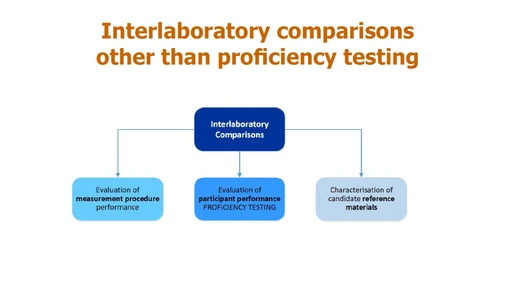
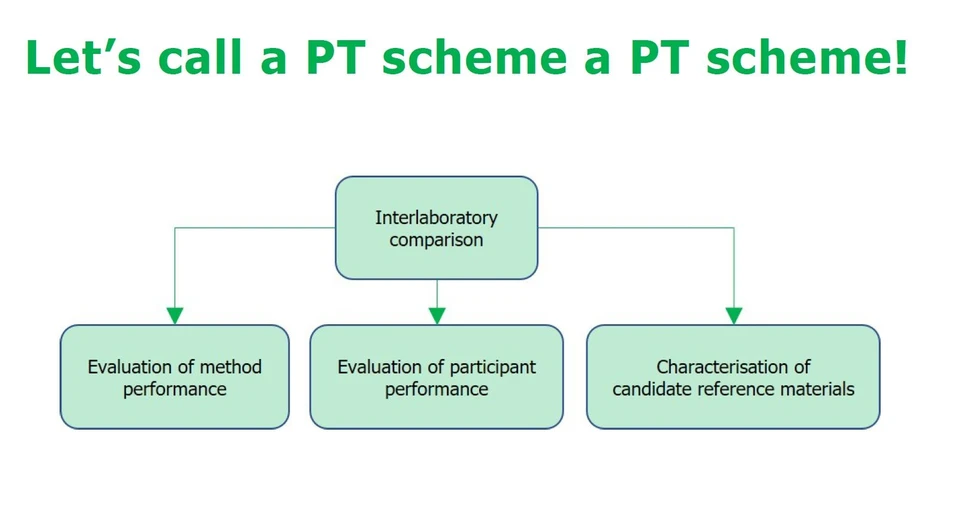
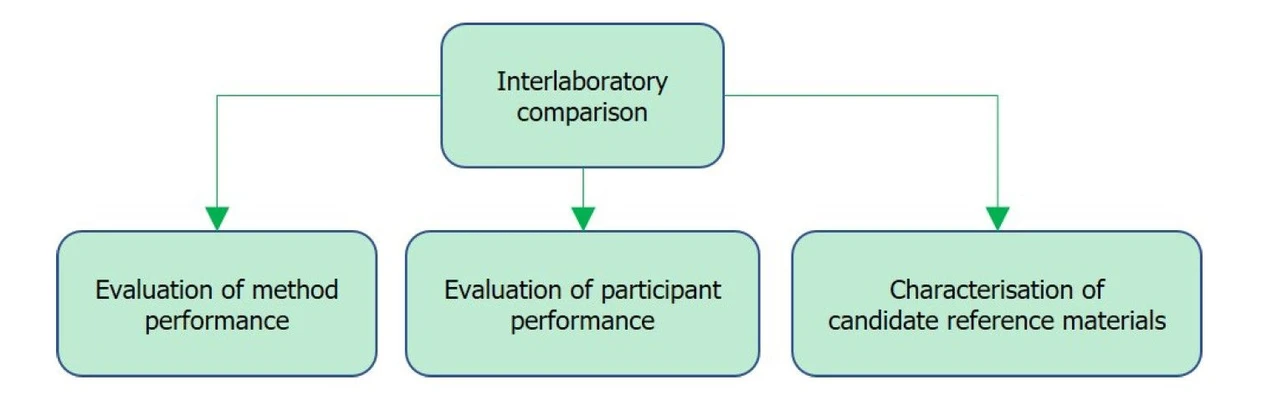
An ‘ILC’ is the organisation, performance and evaluation of measurements or tests on the same or similar items by two or more laboratories in accordance with predetermined conditions [1]. ILCs have a variety of overall – and detailed – objectives, the three most common [2] being:
 Eurachem: Let’s call a PT scheme a PT scheme
Some comparisons have special names
The evaluation of participant (laboratory, organisation or individual) performance is typically referred to as ‘proficiency testing’ (PT) or ‘external quality assessment’ [1]. When the main objective is evaluating the performance of, for example, a candidate standard method, the ILC is often called a ‘method performance study’ or a ‘collaborative study’ [2, 3]. The former is quite clear whereas wording such as “collaborative” and “cooperative” just stresses joint effort. A project aimed at producing a new certified reference material may involve several laboratories conducting analyses on agreed properties [4]. Not surprisingly, this work is sometimes labelled as a ‘material certification study’. Special ILCs used to demonstrate measurement capabilities of National Metrology Institutes are called ‘key comparisons’, ‘supplementary comparisons’, and ‘pilot studies’ [5].
Some terms can be confusing
Other terms for ILCs, including ‘ring test’, ‘round robin’ and ‘circle analysis’, are common in the literature. They have, however, been used for different objectives and different designs and may be ambiguous or understood differently by laboratory staff. The use of these terms may, for example, imply a specific way of distributing the ILC sample. ISO/IEC 17043 uses ‘sequential scheme’, for a PT where a unique item is transferred between the participants and ‘simultaneous scheme’, in which similar items from a batch are distributed simultaneously to the participants [1].
Terms like ‘measurement audit’, ‘interlaboratory testing scheme’, ‘measurement comparison scheme’, ‘rapid performance evaluation scheme’ and ‘intercalibration’ may not correctly reflect the category of laboratory involved, or the type of work participants do during the ILC.
When in 1994 the IUPAC defined and described three major types of ‘interlaboratory studies’, the word ‘study’ was preferred to synonyms such as ‘trial’, ‘exercise’, ‘test’, ‘evaluation’ or ‘check’ [2].
Let’s try to harmonise
Many laboratory staff are unaware of official terms related to ILCs but recognise the acronym PT and words like ‘ring test’. Ideally, we would use a common scientific language, but harmonisation is time consuming. Terms appear and disappear and definitions change. The same term can be defined differently, even in different international standards. Lack of standards and guidelines in local languages can cause confusion and contribute to spreading of less appropriate terms.
 Eurachem: Let’s call a PT scheme a PT scheme
Much confusion can be avoided by clear reference to relevant standards and sectoral guides. ISO/ IEC 17043 [1] and ISO 13528 [6] contain many important concepts related to PT schemes and other ILCs. Some of these are also incorporated into ISO/IEC 17025 [7]. Additional useful, and free, tools are the Eurachem PT Guide [8] and the ISO online browsing platform [9].
In writing guidance and instructions, remember that the term ‘interlaboratory comparison’ has a broad meaning and can be used for all cases described above. Sometimes this is clear enough for the reader. In other cases, use acknowledged terms that reflect the detailed objective of the ILC. Let’s call a PT scheme a PT scheme!
[1] ISO/IEC 17043:2010, Conformity assessment — General requirements for proficiency testing, ISO Geneva (2010).
[2] W. Horwitz, Nomenclature of interlaboratory studies (IUPAC Recommendations 1994), Pure & Appl. Chem., 66(9), 1903-1911.
[3] ISO 5725–2:2019, Accuracy (trueness and precision) of measurement methods and results — Part 2: Basic method for the determination of repeatability and reproducibility of a standard measurement method, ISO Geneva (2019).
[4] ISO Guide 35:2017, Reference materials — Guidance for characterization and assessment of homogeneity and stability, ISO Geneva (2017).
[5] www.bipm.org.
[6] ISO 13528:2015, Statistical methods for use in proficiency testing by interlaboratory comparison, ISO Geneva (2015).
[7] ISO/IEC 17025:2017, General requirements for the competence of testing and calibration laboratories, ISO Geneva (2017).
[8] B. Brookman and I. Mann (eds.) Eurachem Guide: Selection, Use and Interpretation of Proficiency Testing (PT) Schemes (3rd ed. 2021). Available from www.eurachem.org.
[9] www.iso.org/obp.