Author
Phenomenex
Phenomenex
Phenomenex is a global technology leader committed to developing novel analytical chemistry solutions that solve the separation and purification challenges of researchers in industrial, government and academic laboratories.
Tags
Article
Academy
LinkedIn Logo

What You Need to Know About Electron Capture Detectors
We, 20.5.2026
| Original article from: Phenomenex
Learn how Electron Capture Detectors (ECD) work in gas chromatography, including their operating principle, selectivity, sensitivity, and key practical considerations.
<p><strong>Phenomenex: </strong>What You Need to Know About Electron Capture Detectors</p>

Phenomenex: What You Need to Know About Electron Capture Detectors

There are various ways to categorize gas chromatographic detectors. The main classifications include:

  1. Detectors sensitive to concentration vs mass flow rate sensitive detectors
  2. Selective vs universal (non-selective) detectors
  3. Non-destructive vs destructive detectors

A concentration-sensitive detector is one in which the peak response depends on the absolute analyte concentration. At constant concentration, the response is constant regardless of change in flow rate of the carrier gas. If the flow rate changed, there will be no effect on the peak height of the analytes.

On the other hand, a mass flow rate sensitive detector is one in which the peak response changes with the flow rate of the carrier gas. In other words, if the carrier gas flow rate is decreased, there will be a proportional decrease in peak height.

Universal detectors can see a wider variety of compounds, whilst a selective detector is very specific to certain chemical elements or groups. Non-destructive detectors maintain the same structure of the analytes as they had whilst passing through the column, while destructive detectors break down the actual molecule to produce signals.

In GC analysis there is not much significance if the detector is destructive or non-destructive as there is no preparative work involved.

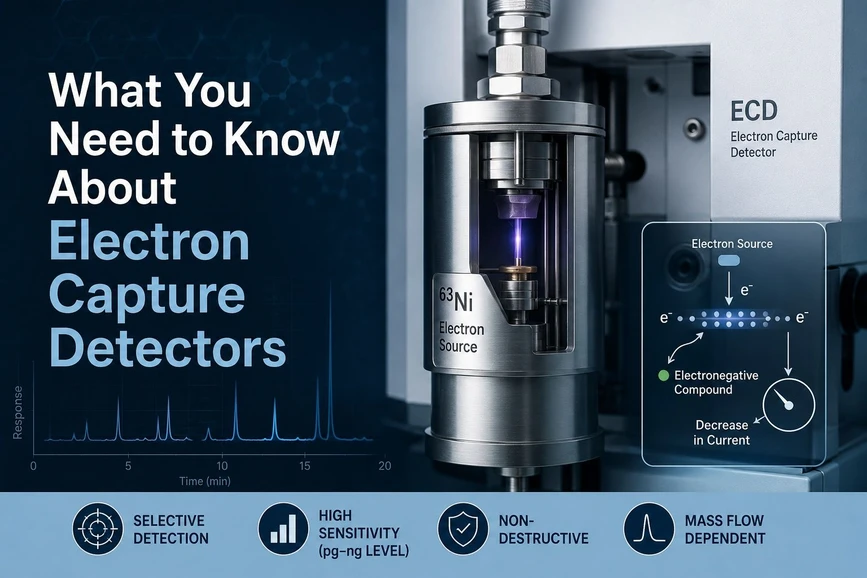
Electron capture detectors (ECD) are mass flow dependent detectors selective to electronegative elements and they are also non-destructive. ECD is actually the go-to and most sensitive detector for the analysis of electronegative compounds.

The carrier gas is ionized by an electron source such as 3H or 63Ni. A low-energy stream of electrons produces a steady current that is magnified and measured. The current decreases when an electron-capturing compound enters the detector. Loss of electrons by the electronegative compound is measured as the signal.

ECD can detect from the picogram to nanogram level of concentration. As ECD is selective for electronegative compounds, it is the go-to detector for halogenated compounds, nitrogen-, oxygen-, and carbonyl group-containing compounds.

Points to Remember About ECD

  • The ECD detector has a radioactive element in it. Maintenance of the detector should be performed only by qualified professionals with appropriate radioactive shielding. Hardware disposal is strictly regulated by local legislation.
  • The ECD is compatible with ultra-high-purity nitrogen and helium as the carrier gas.
  • Since the detector is a mass flow rate detector, there is a proportional impact on peak area and peak height with change in flow rate. The method should be run under constant flow mode for quantitative analysis.
  • Nitrogen or argon-methane mixture can be used as makeup gases. The makeup gas flow and composition should be optimized for higher sensitivity and maintained constantly between consecutive runs to obtain reproducible quantitative results.
  • The detector should operate at the temperature mentioned in the detector’s user manual. Usually, the upper limits are 350–400 °C, depending on the manufacturer and model. Most ECDs are equipped with automatic shut-down if the temperature limit is exceeded.
  • The carrier gas used for analysis should be free of oxygen, moisture, and halocarbons to extend detector lifetime and avoid baseline problems.

ECDs can be baked out at higher temperatures to clean them. However, the bakeout temperature should not exceed the maximum limit mentioned in the detector’s user guide. Since ECD contains a radioactive beta particle source, no attempt should be made to clean the detector mechanically.

Phenomenex
LinkedIn Logo
 

Related content

Alcohol Determination of Sanitizer Gel Using Nexis GC-2060

Applications
| 2026 | Shimadzu
Instrumentation
GC
Manufacturer
Shimadzu
Industries
Pharma & Biopharma

Sensitive and Reproducible Determination of Nitrosamines by GC/MSD

Applications
| 2026 | Agilent Technologies
Instrumentation
GC/MSD, GC/SQ
Manufacturer
Agilent Technologies
Industries
Environmental

High-Throughput BTEX Analysis in Nail Products by SPME and GC/TQ

Applications
| 2026 | Agilent Technologies
Instrumentation
GC/MSD, GC/MS/MS, GC/QQQ, SPME
Manufacturer
Agilent Technologies
Industries
Materials Testing

Accurate multi-component blast furnace gas analysis maximizes iron production and minimizes coke consumption

Applications
| 2026 | Thermo Fisher Scientific
Instrumentation
GC/MSD
Manufacturer
Thermo Fisher Scientific
Industries
Energy & Chemicals

Gas Chromatograph Nexis GC-2060

Brochures and specifications
| 2026 | Shimadzu
Instrumentation
GC
Manufacturer
Shimadzu
Industries
Other
 

Related articles

Advantages and Disadvantages of Substitution of Helium as Carrier Gas in Gas Chromatography by Hydrogen. Part I. – Technical and Safety Aspects
Scientific article | Academy

Advantages and Disadvantages of Substitution of Helium as Carrier Gas in Gas Chromatography by Hydrogen. Part I. – Technical and Safety Aspects

Some difficulties with substitution of helium as carrier gas by another gas are discussed in this series of papers. Laboratories may be forced to make this change due to “helium crisis”.
The journal Kvasny Prumysl
tag
share
more
Advantages and disadvantages of substitution of helium as carrier gas in gas chromatography by hydrogen. Part III. - Sample introduction and detectors.
Scientific article | Academy

Advantages and disadvantages of substitution of helium as carrier gas in gas chromatography by hydrogen. Part III. - Sample introduction and detectors.

This paper addresses some specifics concerning the use of hydrogen as carrier gas in different techniques of sample introduction on chromatographic column.
The journal Kvasny Prumysl
tag
share
more
Main gas chromatographic detectors used in brewing analytics
Article | Academy

Main gas chromatographic detectors used in brewing analytics

In brewing analytics the most frequently used gas chromatographic detectors are (FID), (ECD), and (FPD). This work is focused on principles, their advantages and limitations during using in brewing analytics.
The journal Kvasny Prumysl
tag
share
more
GC & GC/MS Helium to Hydrogen Conversion Quick Reference Guide
Article | Science and research

GC & GC/MS Helium to Hydrogen Conversion Quick Reference Guide

This quick reference guide is set out to provide information on using and converting a instrument or a whole laboratory from helium to hydrogen.
ChromSolutions
tag
share
more
 

Related content

Alcohol Determination of Sanitizer Gel Using Nexis GC-2060

Applications
| 2026 | Shimadzu
Instrumentation
GC
Manufacturer
Shimadzu
Industries
Pharma & Biopharma

Sensitive and Reproducible Determination of Nitrosamines by GC/MSD

Applications
| 2026 | Agilent Technologies
Instrumentation
GC/MSD, GC/SQ
Manufacturer
Agilent Technologies
Industries
Environmental

High-Throughput BTEX Analysis in Nail Products by SPME and GC/TQ

Applications
| 2026 | Agilent Technologies
Instrumentation
GC/MSD, GC/MS/MS, GC/QQQ, SPME
Manufacturer
Agilent Technologies
Industries
Materials Testing

Accurate multi-component blast furnace gas analysis maximizes iron production and minimizes coke consumption

Applications
| 2026 | Thermo Fisher Scientific
Instrumentation
GC/MSD
Manufacturer
Thermo Fisher Scientific
Industries
Energy & Chemicals

Gas Chromatograph Nexis GC-2060

Brochures and specifications
| 2026 | Shimadzu
Instrumentation
GC
Manufacturer
Shimadzu
Industries
Other
 

Related articles

Advantages and Disadvantages of Substitution of Helium as Carrier Gas in Gas Chromatography by Hydrogen. Part I. – Technical and Safety Aspects
Scientific article | Academy

Advantages and Disadvantages of Substitution of Helium as Carrier Gas in Gas Chromatography by Hydrogen. Part I. – Technical and Safety Aspects

Some difficulties with substitution of helium as carrier gas by another gas are discussed in this series of papers. Laboratories may be forced to make this change due to “helium crisis”.
The journal Kvasny Prumysl
tag
share
more
Advantages and disadvantages of substitution of helium as carrier gas in gas chromatography by hydrogen. Part III. - Sample introduction and detectors.
Scientific article | Academy

Advantages and disadvantages of substitution of helium as carrier gas in gas chromatography by hydrogen. Part III. - Sample introduction and detectors.

This paper addresses some specifics concerning the use of hydrogen as carrier gas in different techniques of sample introduction on chromatographic column.
The journal Kvasny Prumysl
tag
share
more
Main gas chromatographic detectors used in brewing analytics
Article | Academy

Main gas chromatographic detectors used in brewing analytics

In brewing analytics the most frequently used gas chromatographic detectors are (FID), (ECD), and (FPD). This work is focused on principles, their advantages and limitations during using in brewing analytics.
The journal Kvasny Prumysl
tag
share
more
GC & GC/MS Helium to Hydrogen Conversion Quick Reference Guide
Article | Science and research

GC & GC/MS Helium to Hydrogen Conversion Quick Reference Guide

This quick reference guide is set out to provide information on using and converting a instrument or a whole laboratory from helium to hydrogen.
ChromSolutions
tag
share
more
 

Related content

Alcohol Determination of Sanitizer Gel Using Nexis GC-2060

Applications
| 2026 | Shimadzu
Instrumentation
GC
Manufacturer
Shimadzu
Industries
Pharma & Biopharma

Sensitive and Reproducible Determination of Nitrosamines by GC/MSD

Applications
| 2026 | Agilent Technologies
Instrumentation
GC/MSD, GC/SQ
Manufacturer
Agilent Technologies
Industries
Environmental

High-Throughput BTEX Analysis in Nail Products by SPME and GC/TQ

Applications
| 2026 | Agilent Technologies
Instrumentation
GC/MSD, GC/MS/MS, GC/QQQ, SPME
Manufacturer
Agilent Technologies
Industries
Materials Testing

Accurate multi-component blast furnace gas analysis maximizes iron production and minimizes coke consumption

Applications
| 2026 | Thermo Fisher Scientific
Instrumentation
GC/MSD
Manufacturer
Thermo Fisher Scientific
Industries
Energy & Chemicals

Gas Chromatograph Nexis GC-2060

Brochures and specifications
| 2026 | Shimadzu
Instrumentation
GC
Manufacturer
Shimadzu
Industries
Other
 

Related articles

Advantages and Disadvantages of Substitution of Helium as Carrier Gas in Gas Chromatography by Hydrogen. Part I. – Technical and Safety Aspects
Scientific article | Academy

Advantages and Disadvantages of Substitution of Helium as Carrier Gas in Gas Chromatography by Hydrogen. Part I. – Technical and Safety Aspects

Some difficulties with substitution of helium as carrier gas by another gas are discussed in this series of papers. Laboratories may be forced to make this change due to “helium crisis”.
The journal Kvasny Prumysl
tag
share
more
Advantages and disadvantages of substitution of helium as carrier gas in gas chromatography by hydrogen. Part III. - Sample introduction and detectors.
Scientific article | Academy

Advantages and disadvantages of substitution of helium as carrier gas in gas chromatography by hydrogen. Part III. - Sample introduction and detectors.

This paper addresses some specifics concerning the use of hydrogen as carrier gas in different techniques of sample introduction on chromatographic column.
The journal Kvasny Prumysl
tag
share
more
Main gas chromatographic detectors used in brewing analytics
Article | Academy

Main gas chromatographic detectors used in brewing analytics

In brewing analytics the most frequently used gas chromatographic detectors are (FID), (ECD), and (FPD). This work is focused on principles, their advantages and limitations during using in brewing analytics.
The journal Kvasny Prumysl
tag
share
more
GC & GC/MS Helium to Hydrogen Conversion Quick Reference Guide
Article | Science and research

GC & GC/MS Helium to Hydrogen Conversion Quick Reference Guide

This quick reference guide is set out to provide information on using and converting a instrument or a whole laboratory from helium to hydrogen.
ChromSolutions
tag
share
more
 

Related content

Alcohol Determination of Sanitizer Gel Using Nexis GC-2060

Applications
| 2026 | Shimadzu
Instrumentation
GC
Manufacturer
Shimadzu
Industries
Pharma & Biopharma

Sensitive and Reproducible Determination of Nitrosamines by GC/MSD

Applications
| 2026 | Agilent Technologies
Instrumentation
GC/MSD, GC/SQ
Manufacturer
Agilent Technologies
Industries
Environmental

High-Throughput BTEX Analysis in Nail Products by SPME and GC/TQ

Applications
| 2026 | Agilent Technologies
Instrumentation
GC/MSD, GC/MS/MS, GC/QQQ, SPME
Manufacturer
Agilent Technologies
Industries
Materials Testing

Accurate multi-component blast furnace gas analysis maximizes iron production and minimizes coke consumption

Applications
| 2026 | Thermo Fisher Scientific
Instrumentation
GC/MSD
Manufacturer
Thermo Fisher Scientific
Industries
Energy & Chemicals

Gas Chromatograph Nexis GC-2060

Brochures and specifications
| 2026 | Shimadzu
Instrumentation
GC
Manufacturer
Shimadzu
Industries
Other
 

Related articles

Advantages and Disadvantages of Substitution of Helium as Carrier Gas in Gas Chromatography by Hydrogen. Part I. – Technical and Safety Aspects
Scientific article | Academy

Advantages and Disadvantages of Substitution of Helium as Carrier Gas in Gas Chromatography by Hydrogen. Part I. – Technical and Safety Aspects

Some difficulties with substitution of helium as carrier gas by another gas are discussed in this series of papers. Laboratories may be forced to make this change due to “helium crisis”.
The journal Kvasny Prumysl
tag
share
more
Advantages and disadvantages of substitution of helium as carrier gas in gas chromatography by hydrogen. Part III. - Sample introduction and detectors.
Scientific article | Academy

Advantages and disadvantages of substitution of helium as carrier gas in gas chromatography by hydrogen. Part III. - Sample introduction and detectors.

This paper addresses some specifics concerning the use of hydrogen as carrier gas in different techniques of sample introduction on chromatographic column.
The journal Kvasny Prumysl
tag
share
more
Main gas chromatographic detectors used in brewing analytics
Article | Academy

Main gas chromatographic detectors used in brewing analytics

In brewing analytics the most frequently used gas chromatographic detectors are (FID), (ECD), and (FPD). This work is focused on principles, their advantages and limitations during using in brewing analytics.
The journal Kvasny Prumysl
tag
share
more
GC & GC/MS Helium to Hydrogen Conversion Quick Reference Guide
Article | Science and research

GC & GC/MS Helium to Hydrogen Conversion Quick Reference Guide

This quick reference guide is set out to provide information on using and converting a instrument or a whole laboratory from helium to hydrogen.
ChromSolutions
tag
share
more
Other projects
LCMS
ICPMS
Follow us
FacebookX (Twitter)LinkedInYouTube
More information
WebinarsAbout usContact usTerms of use
LabRulez s.r.o. All rights reserved. Content available under a CC BY-SA 4.0 Attribution-ShareAlike