Counting Double Bonds: GCxGC–FID For Plastic Pyrolysis Oils (Petr Vozka, MDCW 2026)
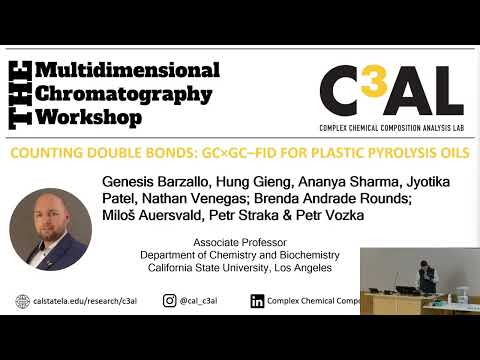
- Photo: MDCW: Counting Double Bonds: GCxGC–FID For Plastic Pyrolysis Oils (Petr Vozka, MDCW 2026)
- Video: LabRulez: Petr Vozka: Counting Double Bonds: GCxGC–FID for Plastic Pyrolysis Oils (MDCW 2026)
🎤 Presenter: Petr Vozka (California State University LA)
Abstract
Microplastics (MPs) are pervasive pollutants throughout our local marine environments. They serve as vectors for organic compounds, yet the variability of their adsorbed contaminants along highly urbanized coastlines remains poorly resolved.
This study examines the variation in MP contamination and its associated organic compounds across three beach sites in the greater Los Angeles region. Surface sediments will be collected from each site. MPs will be isolated through a density separation to remove inorganic components, followed by oxidative digestion of the remaining organic matter. The recovered MPs will be characterized using an inlet capable of high-temperature thermal desorption/pyrolysis coupled with two-dimensional gas chromatography-time-of-flight mass spectrometry (GCxGC-TOFMS) to identify polymer-specific marker compounds and thereby determine MP composition and relative abundance at each location. In addition, a preliminary thermal desorption (TD) step will be applied before pyrolysis to assess organic compounds adsorbed to MP surfaces. Chromatographic profiles from the single-step TD/PY-GC×GC-TOF-MS analyses will be statistically compared among sites using Chromatof Sync 2D software to evaluate differences in both polymer types and co-occurring contaminants. The results will provide insight into how local sources, hydrodynamics, and land use patterns influence the distribution of MP polymers and their adsorbed contaminant loads along urbanized Southern California coastlines.
Video Transcription
In this presentation, Petr Vozka (California State University, Los Angeles) addresses a critical analytical challenge associated with chemical recycling of plastics—namely, the detailed characterization of unsaturated hydrocarbons (olefins) formed during depolymerization processes.
Plastic waste recycling remains a major global issue, with most materials still ending up in landfills. Emerging thermochemical and catalytic recycling approaches convert plastic waste into fuel-like products. However, these products are highly complex mixtures containing a broad distribution of hydrocarbons, particularly olefins, whose accurate quantification and classification remain analytically demanding.
Unlike conventional petroleum-derived fuels, plastic pyrolysis oils may contain up to ~50 wt.% olefins, making traditional analytical methods insufficient.
Why Olefin Characterization Matters
Olefin content directly impacts:
- Fuel stability and reactivity
- Downstream upgrading processes
- Material compatibility and storage
- Environmental and regulatory compliance
However, most standard methods (e.g., bromine number, FIA) only provide bulk unsaturation metrics and lack structural resolution.
Additionally, these methods can produce misleading results, especially in complex matrices:
- Misclassification of compounds (e.g., dienes or heteroatom species as aromatics)
- Poor performance at high olefin concentrations
- Limited chemical specificity
Role of GC×GC-FID in Complex Hydrocarbon Analysis
To address these challenges, the group employs comprehensive two-dimensional gas chromatography (GC×GC) with FID detection, which offers:
- High peak capacity
- Structured chromatographic separation
- Quantitative robustness for hydrocarbons
Using reverse-phase GC×GC, hydrocarbons can be organized into regions:
- n-alkanes
- isoalkanes
- cycloalkanes
- aromatics
However, a key finding of this work is that olefins are not confined to a single chromatographic region, as often assumed in literature. Instead:
- Mono-unsaturated compounds co-elute with isoalkanes and monocycloalkanes
- Di- and poly-unsaturated species appear in higher-order cyclic regions
- Distribution follows a systematic trend linked to double bond count
This significantly complicates direct quantification.
Approach 1: GC×GC Combined with Selective Adsorption
The first strategy combines GC×GC-FID with silver-modified silica adsorption:
Principle:
- Olefins are selectively retained on the cartridge
- Sample is analyzed before and after treatment
- Olefin content is calculated from peak area differences
Key features:
- Sample volume: ~50 µL
- Analysis time: ~15 minutes
- Quantification based on weight % (FID response)
Advantages:
- Simple and cost-effective
- Provides group-type quantification
- Suitable for high-olefin samples
Limitations:
- Reliable only above ~5 wt.% olefins
- Primarily applicable to aliphatic olefins
- Limited performance for heavier or aromatic systems
- Co-elution effects may distort alkane quantification
Notably, results showed that alkanes can be overestimated if olefins are not properly removed prior to quantification.
Approach 2: Chemical Derivatization for Olefin Identification
The second strategy focuses on chemical derivatization of double bonds, enabling more detailed structural analysis.
Classical Method: DMDS Derivatization
- Reagent: dimethyl disulfide (DMDS) + iodine
- Reaction at ~70 °C for 1 hour
- Converts olefins into heavier, more polar derivatives
- Shifts peaks to different regions in GC×GC space
Outcome:
- Enables differentiation between saturated and unsaturated species
- Allows carbon-number-resolved quantification
- Provides detailed group-type analysis
Limitations:
- DMDS not sufficiently heavy → incomplete chromatographic shift in complex samples
- Overlap with aromatic region complicates interpretation
- Formation of DMDS-related artifacts
- Requires elevated temperature
- Regulatory challenges (iodine handling)
Next-Generation Derivatization Strategy
To overcome these limitations, the group explored alternative disulfide reagents with improved properties:
- Higher molecular weight → better chromatographic separation
- Improved polarity → enhanced peak shifting
- Reaction at room temperature
- Reduced reliance on iodine (under development)
Verification using ¹H NMR confirmed complete consumption of double bonds, demonstrating full derivatization.
This new approach significantly improves applicability for:
- Jet fuel and diesel-range samples
- Highly complex pyrolysis oils
- Advanced structural characterization
Analytical Impact and Future Directions
This work demonstrates that combining GC×GC with targeted sample preparation strategies enables:
- Detailed olefin quantification beyond bulk parameters
- Improved classification of complex hydrocarbon mixtures
- Better understanding of plastic depolymerization pathways
Future developments include:
- Integration with TOF-MS for structural confirmation
- Potential coupling with VUV detection
- Full method validation across feedstocks
- Expansion toward aromatic olefin analysis
Conclusion
Accurate characterization of olefins in plastic recycling streams requires moving beyond conventional bulk methods. The combination of GC×GC separation with selective adsorption and advanced derivatization provides a powerful analytical toolbox for resolving these complex systems.
This work highlights the importance of method development tailored to emerging matrices, particularly in the context of circular economy and sustainable materials.
This text has been automatically transcribed from a video presentation using AI technology. It may contain inaccuracies and is not guaranteed to be 100% correct.
-Workshop-LOGO_s.webp)


_s.webp)


_s.webp)